

About Washington Thriving
What is Washington Thriving?
Washington Thriving Strategic Plan is a collaborative statewide effort to transform the behavioral health system serving children, youth, and young adults from before they are born through age 25 when their brains are fully matured.
Centering lived experience. Envisioning the future. Leading the way.
Shared Vision
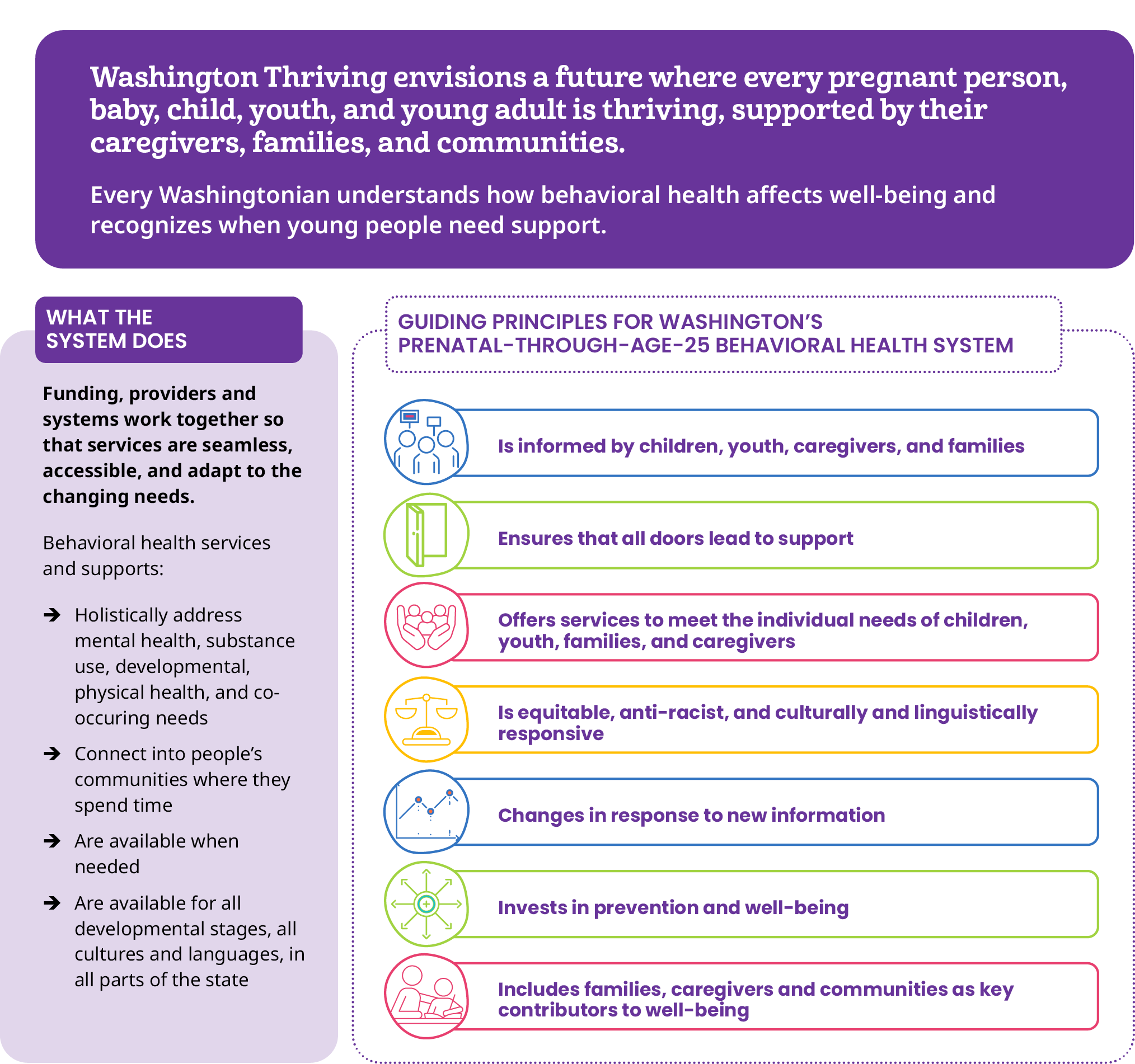
Definition of behavioral health
Behavioral health involves the interaction between a person’s body, brain, and the people and places around them and includes the feelings and actions that can affect one’s overall well-being.
Behavioral health can:
Impact how a person relates to and interacts with their families and communities and maintain long-term positive relationships that are vital for well-being
Affects a person’s physical body and overall well-being in the same way that a short-term or long-term illness might
Stem from many things, including the stress and trauma they have experienced or experiencing or challenges with substances or other ways of coping that get in the way of overall well-being
Can include a broad range of diagnoses and can change or be exacerbated by lack of intervention
Coincide with other things, including the impacts of communities’ being under-resourced, homelessness, disruption of schooling, challenges finding employment, and youth being at risk of incarceration. These other things can be both a “cause of” or “result of” behavioral health challenges
Lead to children, youth, and young adults strugglingto navigate life, maintain positive relationships, achieve their educational goals, and adapt to change
Intersect with intellectual and developmental disabilities and compound their impacts.
Be impacted even before birth and through exposure to maternal stress or substances and/or poor social and emotional connections during the earliest months and years of life
Information on how this definition was developed can be found here.
-
2022
The Children and Youth Behavioral Health Work Group (CYBHWG) recommended the development of a statewide prenatal through 25 (P-25) behavioral health strategic plan. This recommendation was passed by the Washington State legislature in Second Substitute House Bill 1890.
-
2023
A Strategic Plan Advisory Group composed of individuals with lived experience was established to develop a vision and principles for the future of Washington’s behavioral health system for prenatal-through-age-25. .
Conducted an inventory of state-sponsored programs and services.
-
2024
Engrossed House Bill 2256 extended the due date for the P-25 behavioral health strategic plan to November 1, 2025.
The Strategic Plan Advisory Group expanded to include other interested actors alongside those with lived experience.
New workstreams launched (community engagement, research and analysis) to inform the strategic plan.
The process of developing the strategic plan was dubbed “Washington Thriving” and the advisory group was renamed the Washington Thriving Advisory Group.
-
2025
The Washington Thriving Strategic Plan was submitted to the Washington State legislature.
-
2026
Second Substitute House Bill 2429 was passed by the Washington State Legislature and signed into law by Governor Bob Ferguson.
Implementation efforts of the Washington Thriving Strategic Plan begin. -
Beyond
A brighter future for families, children, and youth in Washington State.
The Team
-
The Health Care Authority administered the budget and coordinated the process to develop the Strategic Plan. They also administer the Children and Youth Behavioral Health Work Group.
Behavioral Health Catalyst, with philanthropic funding, worked closely with the co-chairs, HCA, and partners to guide the process of developing the plan and integrate many diverse inputs into a compelling and coherent strategic plan. They have mobilized additional philanthropic funding to support the plan’s implementation and are now working closely with the Governor’s Office and the co-chairs of the Children and Youth Behavioral Health Work Group to implement HB2429 and the Strategic Plan’s First Initiatives.
-
Bloom Works conducted four discovery sprints that informed the strategic plan. Behavioral Health Catalyst has raised funding to continue Bloom Work’s work in support of First Initiatives 2 (perinatal wellbeing) and 3 (K-12 student behavioral health).
University of Washington's CoLab for Community and Behavioral Health Policy is supporting First Initiative 3 by leading a co-design process that will produce a policy recommendation and implementation plan for a technical assistance and training network to support K-12 school behavioral health.
Pontifex Consulting facilitated a multisector process of mapping the behavioral health system dynamics for young people and families in Washington, to help visualize the tradeoffs and relative impacts of various investments and interventions.
DidJuno helped design the Washington Thriving logo and visual identity and built the Washington Thriving website.
Minerva Strategies and their collaborators helped design the Strategic Plan document and produced the accompanying web-based version. They also provided strategic communications support around the submission of the Strategic Plan to the legislature.
Health Management Associates helped facilitate the Washington Thriving Advisory Group in 2024, contracted Full Frame Initiative to conduct community listening sessions in 2024, and produced two inputs that informed the Strategic Plan: Qualitative Perspectives on Washington's Prenatal-25 Behavioral Health System and Funding, Oversight, and Administration of Washington’s Prenatal Through Age 25 Behavioral Health Services.
Mercer conducted quantitative analysis of current supply and demand for behavioral health services and supports, identifying relevant data as well as gaps, and proposed a design for a dashboard with key indicators to monitor performance of the behavioral system over time. Quantitative Landscape and Gap Analysis Report
The Strategic Plan
Washington Thriving is a strategic plan that:
Provides a vision for the future of prenatal-through-age-25 behavioral health in Washington State.
Describes the current landscape of behavioral health needs and services, and identifies what’s missing.
Reflects the lived experience of people who seek support from the system and of those who provide support.
Provides a roadmap for building the envisioned system.

Washington Thriving Advisory Group (2024-2025)
The Washington Thriving Advisory Group (previously called the Strategic Plan Advisory Group) was made up of young people, parents, caregivers, providers, agency representatives, and other system partners. This group was led by two co-chairs, Representative Lisa Callan and Diana Cockrell from the Health Care Authority.
The Advisory Group was a platform for diverse actors to find common ground and develop collective suggestions to improve the behavioral health landscape for individuals prenatal through age 25 and their families and caregivers. The group provided input to each workstream as they developed and then provided feedback on the resulting products. The Advisory Group informed the decisions related to the Strategic Plan made by the Children and Youth Behavioral Health Work Group (CYBHWG). The public was welcome to observe Advisory Group meetings.
Three monthly discussion groups provided space for deeper dialogue among key groups: youth and young adults, parents and caregivers, and providers and other system partners. These meetings were open to participation by all.
These groups concluded in their work with the publishing of the Washington Thriving Strategic Plan at the end of 2025.
Discussion Groups (2024-2025)
Discussion groups were one-to-two-hour meetings open to the public that focused on sharing updates about the strategic plan and gathering feedback and suggestions on project outputs from specific populations.
Youth & Young Adults – Youth and young adults (ages 13-29) who have sought or received behavioral health supports or services in Washington
Parents & Caregivers - Individuals with lived experience/living experience as a parent or caregiver to an individual (age 0-25) who has sought or received behavioral health supports or services in Washington and/or have sought or experienced supports or services themselves during pregnancy through one year after birth
System Partners – Behavioral health providers, advocates, and others who support the prenatal through age 25 population and their families/caregivers
