
In July, Washington Thriving announced a project with Bloom Works as part of First Initiative 2, to improve substance use disorder (SUD) care for pregnant and parenting people in Washington. In August, we shared early signals from Bloom Works’ first round of research and promised findings in October.
Those findings are now available in the Sprint 1 findings deck, and in this post, Bloom Works shares a brief summary of the work and what comes next.

What we did
From July to October, we interviewed 37 individuals including parents with lived experience, providers, and subject matter experts, and visited 9 treatment and support programs in Spokane. We worked closely with partners at Washington’s Department of Health (DOH), the Department of Children, Youth, and Families (DCYF), and the Health Care Authority (HCA) throughout.
What we heard
We organized our findings into three layers, which line up with Washington Thriving’s three foundational dimensions. We started with people at the center: what parents and families actually experience. From there, we worked out to services: how care is delivered. Then we moved further out to the system infrastructure: the policy, funding, and structures that shape all of it.
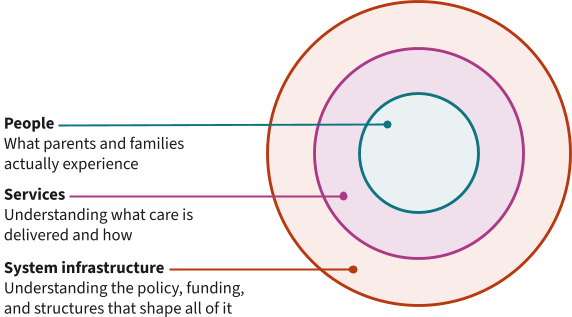
Three layers of findings: People, Services, and System infrastructure.
Parents’ experiences
Parents’ journeys through treatment were long, varied, and nonlinear. Many looped back through the same stages of recovery, sometimes over years. Three themes came up again and again:
Fear of family separation, which can keep parents from seeking help at all
Stigma and judgment, especially from medical providers
Transformation: with the right support, parents described real change in how they saw themselves as people and as parents
“For me, being able to go with my baby was the biggest key piece in my puzzle. I was able to bond and attach with my baby. They [program staff] encouraged me to believe that I could be a mom, that I could take care of her. Had DCYF taken her away I don’t think I would have made it. I would have gone right back to the streets.”
Care that works
Parents and providers described the same qualities in programs that worked. Care was most effective when it was:
Inclusive of the whole family, including partners, co-parents, and children
Long enough for real healing; several parents said they needed 6 to 12 months
Loving, supportive, and empowering, built on relationships as much as clinical services
Integrated and coordinated, so families can meet medical, mental health, dental, housing, and other needs in one place
Programs like this exist in Washington, but there aren't enough of them, and many struggle to stay open.
The system around it
Four structural issues make family-centered care hard to access, start, and sustain:
Capacity: There often aren't openings when families need them. Facilities carry high fixed costs on thin margins, which makes expansion risky.
Funding: Wraparound supports pay off downstream, in fewer child welfare cases and emergency visits, but rarely have stable funding. Each managed care organization (MCO) sets its own rates, and coverage sometimes ends before a program does.
Licensing and regulation: Opening or expanding a family-centered facility means separate approvals from local government, DOH, DCYF, and insurers.
Accountability: Oversight is split across agencies, and providers report data in different ways. That makes it hard for anyone to see the full picture of what's working and what isn’t.
What's next
These findings frame problems, not recommendations. Through October and November, we’ve been bringing them to workshops with parents, providers, and state partners to generate ideas together. Those conversations surfaced a lot of ideas -- more than any one team could take on.
Our funding runs through summer 2027, and we’re now working out how to structure that time so the next phase brings more focus and a bias toward action. That means tight cycles of testing and learning, and working closely with families, providers, and the people who run the system. We also plan to share the full set of ideas from the workshops, organized so others working on perinatal SUD can pick them up and build on them.
Read the full findings
The Sprint 1 findings deck includes parent journey maps, more of what we heard from parents and providers, and the full set of questions guiding the next phase.
We're deeply grateful to the parents and providers who shared their experiences and expertise with us.
Did we miss something, or do you have context to add? Email us at wa-bh-perinatal@bloomworks.digital or share feedback with the Washington Thriving team at info@washingtonthriving.org